I Blamed Screens For My Son's Meltdowns. A Pediatric Nutritionist Told Me I Was Looking at the Wrong Problem.
What Every Parent Needs to Know About Why Kids Today Can't Focus, Can't Calm Down, and Can't Get Through Homework Without a Fight
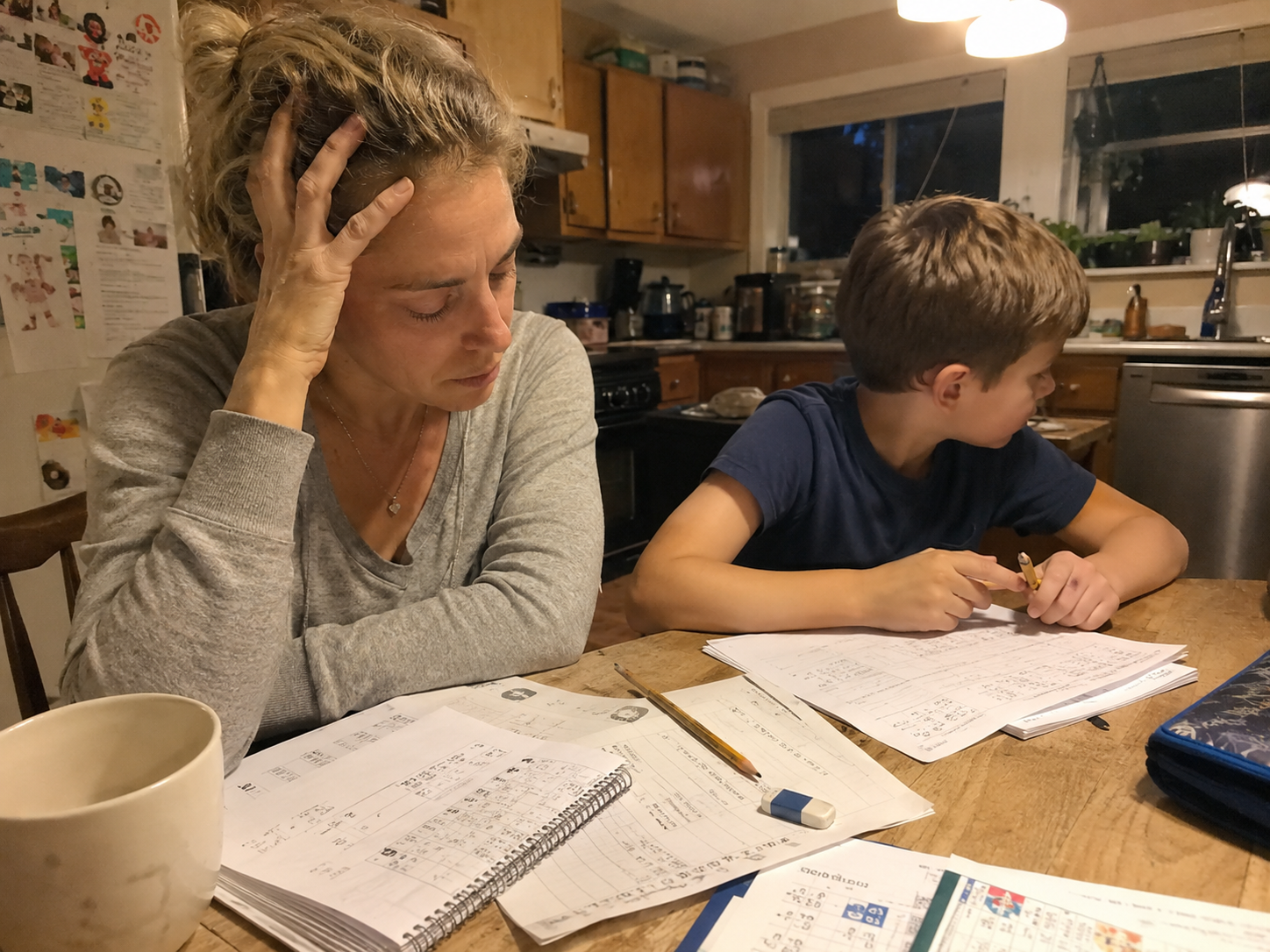
If you've already tried limiting screen time — tried the reward chart, tried consequences, tried being more patient, tried raising your voice (and then lying in bed feeling guilty about it later)...
You've done what every parenting book, every Instagram account, and every well-meaning family member told you to do.
And your kid still can't sit still. Still melts down over nothing. Still fights you on homework every single night. Still turns into a different person the second a screen is in front of them.
What if the problem was never the screens? The problem was never the discipline. And the problem was definitely never you.
What if the real reason your child can't focus, can't regulate their emotions, and can't seem to get through a day without a meltdown — is that their brain is literally missing the nutrients it needs to do those things?
Take the next few minutes and read this. Not because I'm selling you another parenting strategy. But because what you're about to learn is the one thing nobody told me when I was in your exact position — and it changed everything for my family.
I promise you: if your child struggles with focus, mood swings, or emotional meltdowns — this is the most important thing you'll read this year.

Mom of two. And for 18 months, I was convinced my 7-year-old son was becoming a completely different kid.
He used to be the most curious little human. The one building Lego sets for hours, asking "why" about everything, drawing elaborate pictures of dinosaurs with wings and rocket boots.
Then something shifted.
It started slowly. Shorter attention span. More irritable. Small things — like being asked to put his shoes on — would trigger these outsized reactions. Tears. Screaming. Full-body meltdowns over absolutely nothing.
By second grade, homework had become the worst 90 minutes of my day. Every. Single. Night.
"Sit down." "Focus." "Stop fidgeting." "We've been on this page for 20 minutes." "Please just try."
The same script. Every night. Both of us in tears by the end.
And the screens. God, the screens.
He could focus on YouTube for two hours straight without blinking. But ask him to read for 10 minutes? Impossible. Ask him to sit through dinner? Couldn't do it. Ask him to brush his teeth without me standing over him? Forget it.
So I did what every parent does. I blamed the iPad.
I limited screen time. I set timers. I took devices away entirely for two weeks — which went about as well as you'd imagine. He screamed for 45 minutes on Day 1.
Nothing changed. The meltdowns continued. The focus issues continued. The mood swings — fine one second, raging the next — continued.
Reward charts. Consequences. A new bedtime routine. Three parenting books. Conversations with his teacher. Even considered having him evaluated — but I wasn't ready to go down that road. He wasn't "that kid." He was just... struggling. And I didn't know why.
Then came the night that broke me.
It was a Tuesday. He had a simple math worksheet — maybe 15 problems. Easy stuff he already knew. But 40 minutes in, he was sobbing, I was standing over him frustrated, and the words came out before I could stop them:
"What is WRONG with you?! You KNOW this!"
The second I said it, I wanted to take it back. He looked at me with these wet eyes and whispered:
I went to my bedroom and cried. Because he was trying. I could see it. Something was genuinely making it harder for him to focus, harder to regulate his emotions, harder to just... be okay.
I wasn't helping him. And I didn't know how to stop failing him.
What a Nurse Practitioner Mom Said at a Playdate That Changed Everything
A week later, I was picking up my younger one from a playdate when another mom — Jen — mentioned something offhand.
"We started giving Mason these brain drops a couple months ago. I know it sounds weird. But the difference is... honestly kind of shocking."
I almost brushed it off. Brain drops? Sounded like essential oils or crystals or one of those things Instagram moms swear by.
But Jen wasn't that type. She's a nurse practitioner. She's the one who always tells me to "check with your pediatrician" about literally everything.
So I asked what she meant.
"His pediatric nutritionist told us that most kids today are genuinely deficient in the nutrients their brains need to function properly. Like, actually deficient. Omega-3s, magnesium, B-vitamins. And when you fill those gaps, the focus and the emotional regulation just... come back."
She paused. "Mason went from meltdowns every day after school to basically calm. His teacher emailed me asking what changed."
That night, after the kids were in bed, I fell down a research rabbit hole that changed everything I understood about my son's behavior.
It's Not a Screen Problem. It's a Brain Nutrition Problem.
Here's what nobody tells you — what no parenting book mentions, what no screen time article covers, what your pediatrician probably hasn't brought up:
Your child's brain is the most nutrient-hungry organ in their body. It's only about 2% of their body weight, but it consumes 20% of their total energy. And in children — when the brain is still developing at an extraordinary rate — that demand is even higher.
To produce focus, the brain needs dopamine.
To produce calm, it needs GABA.
To regulate mood, it needs serotonin.
These aren't abstract concepts. These are real chemicals your child's brain manufactures every day. And to manufacture them, it needs specific raw materials — the same way a kitchen needs ingredients to make a meal.
Your child's brain is like a kitchen trying to cook three meals at once: Focus, Calm, and Stable Mood. But if you're missing the butter, the eggs, and the flour — it doesn't matter how good the recipe is. The kitchen can't produce anything.
Omega-3 fatty acids, magnesium, B-vitamins, zinc — these are the ingredients. And most kids today simply aren't getting enough of them.
And here's what connected everything for me:
The screens aren't the CAUSE of the problem. They're the SYMPTOM.
When your child's brain can't produce enough dopamine naturally — because it's missing the raw materials — it goes hunting for dopamine in the easiest way possible. High-stimulation screens. YouTube. Short-form videos that deliver little hits of dopamine every few seconds.
Your kid isn't "addicted" to screens because they're weak-willed. Their brain is starving for dopamine and the screen is the only place it can reliably find some.
Why Nothing You've Tried Has Actually Worked
- Screen limits? You removed the symptom, not the cause. Their brain still can't produce enough focus chemicals on its own.
- Reward charts? You're trying to motivate a brain that doesn't have the neurochemical fuel to follow through.
- Stricter discipline? You're punishing a child for something they physiologically can't control right now.
- More exercise and outdoor time? Genuinely helpful — but it won't close a nutritional gap.
None of these address the root cause: a developing brain that is nutritionally depleted.
That's why your kid is still struggling. That's why you're still exhausted. And that's why you feel like nothing works.
It's not you. It's not them. It's what's missing.
The 8-Pathway Approach: What Actually Works
Here's what the research shows — and this is what changed everything for my family:
You can't just throw one nutrient at a developing brain and expect everything to fix itself. Focus isn't powered by a single vitamin. It's powered by an entire system of pathways working together.
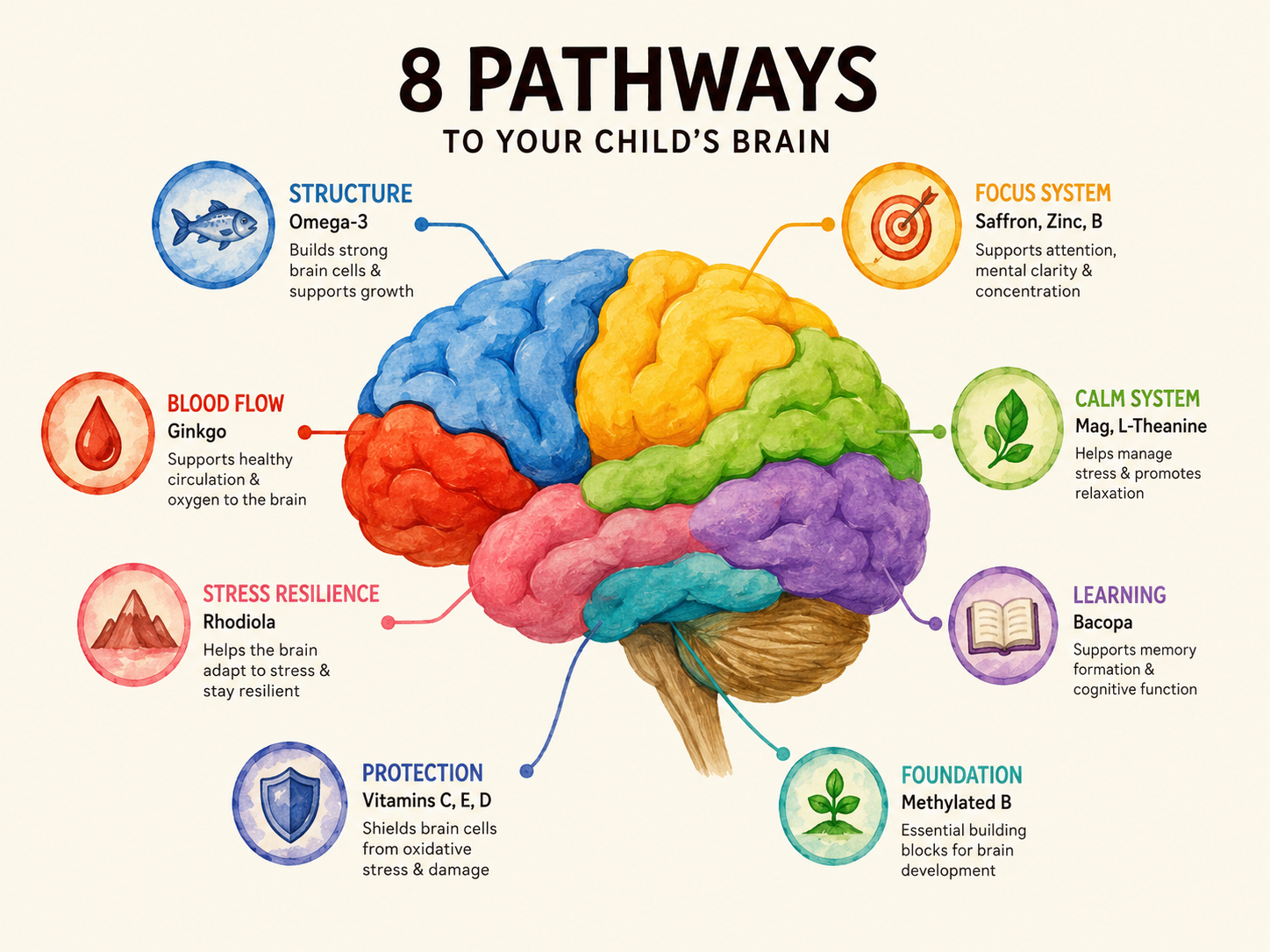
Here's what each pathway does — and what happens when it's running on empty:
Build the Brain's Structure
DHA (an Omega-3 fatty acid) is literally what brain cell membranes are made of. Without enough, brain cells can't communicate properly — like making phone calls with a broken antenna.
Omega-3 (EPA + DHA)Power the Focus System
Dopamine is your child's "focus chemical." Specific nutrients work together to support healthy dopamine levels so the brain can allocate attention without relying on screen stimulation.
Saffron · Zinc · B-VitaminsActivate the Calm System
GABA is the "calm down" signal. This is what helps a child sit still, transition between activities, and not explode when something doesn't go their way.
Magnesium L-Threonate · L-TheanineSupport Learning & Memory
Supports memory formation and information retention. Takes a few weeks to fully build — which is why parents who try random supplements often give up too soon to see results.
Bacopa MonnieriIncrease Brain Blood Flow
More oxygen and glucose reaching the prefrontal cortex — where executive function (planning, organizing, task completion) lives.
Ginkgo BilobaHandle Stress Without Shutdown
That feeling of overwhelm that shuts kids down before they even start? This pathway helps them push through it rather than melting down.
Rhodiola RoseaProtect Developing Brain Tissue
Antioxidants that protect neural tissue during the most critical development window of your child's life.
Vitamins C · E · D3Optimize the Foundation
Methylated B-vitamins ensure the body can actually USE the nutrients it's getting. Standard B-vitamins don't work for up to 40% of kids — methylated forms bypass this entirely.
Methylfolate · Methylcobalamin · P5PA fish oil capsule addresses one pathway out of eight. A magnesium gummy covers one. A multivitamin might touch three, but at doses too low to matter. You need all eight pathways covered at meaningful doses — simultaneously — for the system to work.
The Problem: Nothing on the Market Actually Does This
Once I understood all eight pathways, I started looking for a product that actually covered them. And here's what I found: almost nothing.
Most kids' brain supplements on the market are embarrassing once you read the label:
| What Matters | Generic Brands | Popular Gummies | What's Needed |
|---|---|---|---|
| Omega-3 (DHA+EPA) | ❌ 0-200mg | ❌ Often 0mg | ✅ 600mg+ |
| Magnesium (Brain Form) | ❌ Oxide form | ❌ Missing | ✅ L-Threonate |
| Saffron Extract | ❌ Missing | ❌ Missing | ✅ 25mg |
| B-Vitamins (Methylated) | ❌ Synthetic | ❌ Synthetic | ✅ Active forms |
| Dose Transparency | ❌ "Proprietary Blend" | ❌ Hidden amounts | ✅ Every mg listed |
| Total Pathways Covered | 1-2 | 1-3 | All 8 |
Nobody — literally nobody — had put together a formula that addressed all 8 pathways, at research-backed doses, in forms the brain can actually use.
Until Jen sent me a link to something her nutritionist had been recommending. Something a small company had spent over a year developing specifically for this exact problem.
Brain Drops by Talltitude
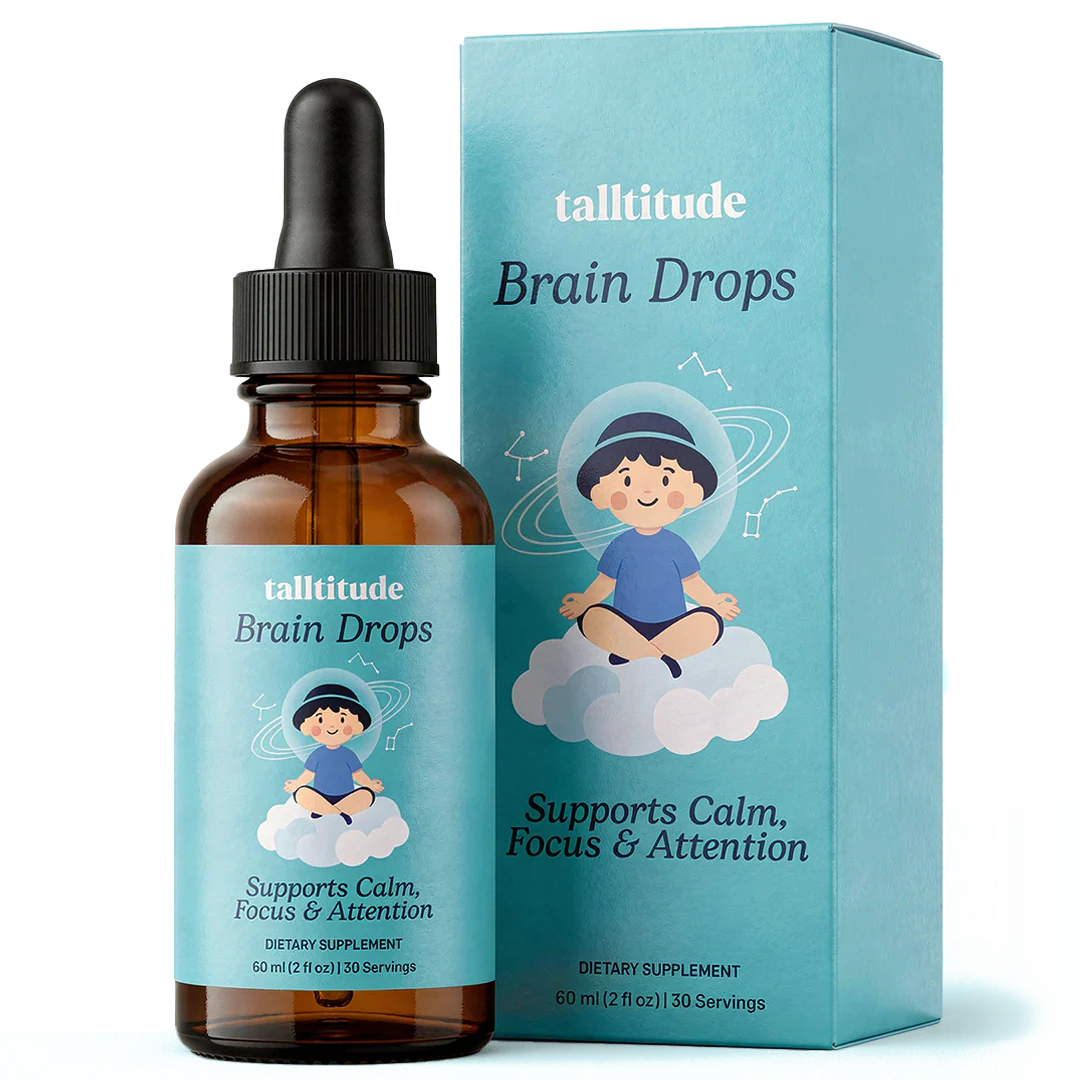
The Formula That Finally Got It Right
15 active ingredients. 8 brain pathways. One daily serving.
When I first looked at the label, I almost couldn't believe it. Every single pathway I'd researched — every nutrient I'd learned about — was there. At doses that actually matched the clinical research.
Omega-3 (EPA + DHA)
This is the amount used in published research. Most kids' supplements contain 100-200mg — a third of what's needed.
Magnesium L-Threonate
The only form of magnesium shown to cross the blood-brain barrier. Most supplements use magnesium oxide — the cheapest form your child's brain can't even access.
Saffron Extract
Studied in children for focus and attention support, with outcomes comparable to conventional approaches in published research. Most brands don't include this at all.
Bacopa Monnieri
Clinical-dose for memory and learning support. Takes 4-6 weeks to fully build — which is why most parents give up on supplements before this ingredient kicks in.
L-Theanine
Promotes calm alertness without drowsiness. The "switched on, not zoned out" ingredient.
Plus 10 More Active Ingredients
Every ingredient chosen for a specific pathway. Every dose printed on the label. No "proprietary blends." Full transparency.
This isn't pills or capsules or chalky tablets. It's berry-flavored liquid drops — two droppers in the morning, straight on the tongue or into a glass of juice. Takes 10 seconds. No sugar. No artificial flavoring. No fishy aftertaste despite the 600mg Omega-3.
My son — the pickiest eater on the planet — takes it without complaint. Some mornings he asks for it before I remember.
60-Day Money-Back Guarantee · Free Shipping Available
What Happened When We Tried It
I'll be honest — I was skeptical. After everything we'd tried, I wasn't expecting much.
Subtle Shifts
He seemed slightly less explosive after school. I wasn't sure if I was imagining it or looking for it. The meltdown on Wednesday was shorter than usual.
Something Changed
Homework went from 90 minutes of fighting to about 45 minutes of mostly focus. He still fidgeted. He still needed breaks. But the meltdowns stopped.
The Email That Made Me Cry
His teacher emailed me — without me saying anything. "I wanted to let you know that your son has been much more engaged this week. He raised his hand four times today, which is unusual for him." I stared at that email and cried in my kitchen.
My Son Came Back
This is the boy I remembered. Not perfect. Not a robot. Not "fixed." But himself. Curious again. Building things. Reading on his own. Getting through homework in 30 minutes without tears. The baseline shifted from chaos to functional — from survival mode to actually enjoying our evenings together.
What Other Parents Are Saying
His teacher emailed me asking what changed. That had never happened before. Not once in three years of school. He's completing assignments without constant supervision. I'm ordering a second bottle.
We went from homework being a nightly war zone to her actually sitting down and doing it. Not perfectly — she's still a kid. But without the crying and screaming? That's everything.
I noticed it most when we ran out and didn't reorder for two weeks. The meltdowns came back. The fighting came back. That's when I knew it wasn't placebo.
I'm a nurse and I don't trust supplement marketing. But the ingredient label convinced me — clinical doses, methylated B-vitamins, actual omega-3 amounts that match the research. My daughter's been calmer and more focused for 3 months now.
60-Day Money-Back Guarantee · Free Shipping Available
What Do You Want the Next 60 Days to Look Like?
You now understand something most parents don't:
- That your child's focus and behavior challenges likely stem from nutritional gaps — not screens, not discipline, and definitely not bad parenting.
- That modern diets leave developing brains starved of the raw materials they need for focus, calm, and mood stability.
- That addressing all 8 brain pathways simultaneously — not just one nutrient at a time — is what produces real, noticeable results.
- That Brain Drops is the only children's brain nutrition formula that covers all 8 pathways at clinical doses, in bioavailable forms, in a format kids actually take.
60 Days From Now (With)
Homework time: 30 minutes, mostly calm.
After school: present, not melting down.
Screens: still enjoys them, but doesn't rage when they end.
Teacher: "He seems more engaged lately."
You: no longer dreading 3:30pm.
60 Days From Now (Without)
Homework: still 90 minutes of fighting.
After school: same meltdowns, same exhaustion.
Screens: still the only thing that "works."
Teacher: same reports, same concerns.
You: still wondering what you're doing wrong.
60-Day Money-Back Guarantee
Give it a real shot — every morning, consistently, for 60 days. If your child's brain doesn't feel the difference: email support@talltitude.com. Full refund, same day. No forms. No return shipping. No awkward back-and-forth.
Less than 1% of parents ask for their money back.
One Last Thing
If your child can focus on a screen for hours but can't sit through 10 minutes of homework — their brain isn't broken. They aren't lazy. They aren't "bad." And you aren't failing them.
Their brain is hungry. It's been running on empty, and it's been begging for help in the only way it knows how — through meltdowns, through mood swings, through that glazed-over look when you ask them to focus on anything that doesn't deliver instant stimulation.
You can keep fighting the symptoms. Or you can feed the cause.
Two drops in their morning juice. Ten seconds of your day. That's all it takes to give their brain the raw materials it's been missing.
60-Day Guarantee · Cancel Anytime · Ships in 4 Days
Their brain is just hungry. Feed it.